
How BeeWeb Rescues Failed Software Projects
The calls usually start the same way.
"Our developer disappeared." "We've spent $80,000 and the app still doesn't work." "The agency says it's 90% done. It's been 90% done for eight months."
If that sounds familiar — you're not alone, and you're not stupid. According to the Project Management Institute, organizations waste an average of $97 million for every $1 billion invested in projects due to poor performance. Roughly 31% of software projects get cancelled before completion, and more than half blow far past their budgets.
Failure is common. What's less common is knowing what to do next.
This is the guide to that next step: what a software project rescue actually is, how BeeWeb does it, what it costs, and how to tell whether your project needs a fix — or a fresh start.
What Is a Software Project Rescue?
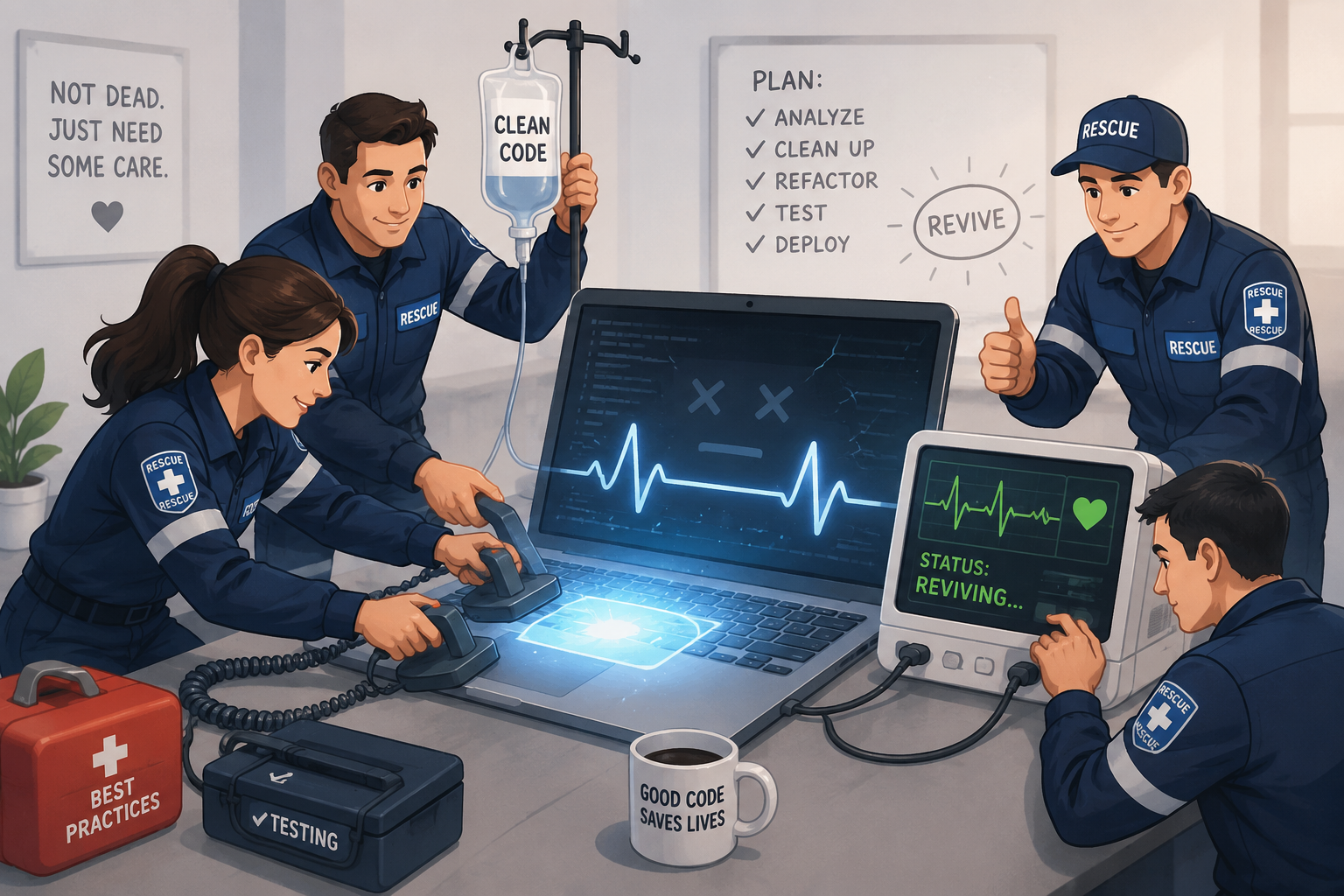
A software project rescue is the process of taking over a failed, stalled, or broken development project and getting it to a working, maintainable state. It follows four steps: audit the existing code, decide what to keep, stabilize what's salvageable, and deliver the rest in a structured way.
A rescue is not the same as "hiring new developers." New developers inherit the mess as-is. A rescue team diagnoses the mess first — then decides what's actually worth keeping.
That order — diagnose before you code — is the difference between a rescue and a second failure.
Rescue vs. rebuild, in one line: a rescue starts with an audit of what exists and keeps whatever still works; a full rebuild throws everything out and starts over. Most projects only need the former — a full rebuild is the exception, not the default.
Why Do Software Projects Fail in the First Place?
Decades of research point to the same handful of causes — and none of them is "wrong technology."
|
Cause |
Share of failures |
Source |
|---|---|---|
|
Poor requirements management |
32–42% |
PMI / Jobera |
|
Communication breakdowns |
57% |
Requiment |
|
Scope creep |
78% of projects affected |
Jobera |
|
Lack of executive sponsorship |
30% |
Standish Group CHAOS Report |
|
Inadequate risk management |
27% of overruns |
McKinsey |
In our experience auditing troubled projects, the code is rarely the root cause. The project failed months before anything broke — when nobody wrote down what "done" meant, when weekly demos stopped happening, when the budget was set by hope instead of scope.
That's actually good news. It means most failed projects contain salvageable work buried under bad process, not unsalvageable code.
"In most rescues, 40–70% of the existing code is usable. The tragedy isn't the code — it's that nobody could tell the founder which 40–70% that was."
For the full breakdown of warning signs and what to do the moment you suspect trouble, read our companion guide: My Software Project Failed — Now What?
Can a Failed Software Project Be Saved?
Usually, yes. In our audits, failed projects sort into three outcomes: recover (fix and continue — the most common outcome), partial rebuild (keep the salvageable core, rebuild the broken parts), or full restart (rare — reserved for unfixable architecture or lost source code).
Three questions decide which category you're in:
▶️Do you have the source code and accounts? If the previous team controls the repositories, servers, and app store accounts, recovering access is step zero. (This is why code ownership belongs in every contract — see how to choose a software development company.)
▶️Is the architecture sound? Ugly code on a solid structure is fixable. Clean-looking code on a broken structure is a trap.
▶️Does the product still match the market? Sometimes the rescue conversation reveals the real problem: months of building without ever validating the idea. In that case, the cheapest rescue is a smaller, smarter MVP — not a resurrection.
Not sure which category your project is in? That's exactly what an audit answers. Book a free consultation — bring whatever you have, even if it's just a broken app and a bad feeling.
How Does BeeWeb Rescue a Failed Project? (Our 5-Step Process)
Audit → Triage → Stabilize → Deliver → Protect. We diagnose before we code, fix the riskiest things first, and put ownership and process in place so the same failure can't happen twice.
Step 1: Technical Audit (1–2 weeks)
We review the codebase, architecture, infrastructure, documentation, and security. You get a written report in plain language: what works, what's broken, what's dangerous, and what it costs to fix.
No jargon walls. If we can't explain the problem simply, we don't understand it well enough yet.
Step 2: Triage Decision
Together we choose the path: recover, partially rebuild, or restart. This is where we tell you things you may not want to hear — including, sometimes, "this doesn't need a rescue, it needs a smaller scope."
An honest triage saves more money than any discount ever will.
Step 3: Stabilize
Before adding anything new, we stop the bleeding: secure the accounts and code ownership, fix critical bugs and security holes, set up proper environments, backups, and monitoring.
A stabilized project buys you time — and negotiating power.
Step 4: Deliver
Now the actual development: rebuilding broken modules, finishing incomplete features, shipping in short, visible increments. You see working software every 1–2 weeks, not a status report saying "90% done."
Step 5: Protect
The rescue isn't finished until the failure can't repeat. That means: your name on every account, documentation that survives any team change, automated tests on the critical paths, and a written definition of "done" for everything that comes next.
Example rescue (illustrative): A logistics startup came to us after 14 months and roughly $120,000 spent with a previous vendor — no working demo, no documentation, and the founder locked out of the production server. The audit took 10 days and found the core data model was sound but the integration layer was rebuilt three times by three different contractors, each undoing the last one's work. We recovered account access in week one, stabilized the environment in three weeks, and shipped a working beta within 9 weeks — reusing roughly 55% of the existing codebase.
(Note: replace this example with a real anonymized case once available — specific, verifiable numbers are what make this section most persuasive to both readers and AI search tools.)
How Much Does a Project Rescue Cost?
A technical audit typically costs $3,000–$10,000 depending on project size. Full rescues vary: stabilization and completion often run 30–60% of the original project budget, while deep partial rebuilds can approach the cost of the original build — but with working software at the end this time.
Two numbers worth holding onto:
▪️A rescue is almost always cheaper than a blind restart. Salvaging 40–70% of existing work is real money saved.
▪️A rescue is always cheaper than continuing to pay a team that isn't delivering. The most expensive project is the one that's "almost done" forever.
Want a realistic number for your specific situation? Our AI Cost Calculator gives you a baseline in minutes — an audit gives you the exact figure.
5 Signs Your Project Needs a Rescue Now
🚩 "90% done" hasn't moved in months. Progress that can't be demonstrated isn't progress.
🚩 You can't access your own code, servers, or app store accounts. This is an emergency, not an inconvenience.
🚩 Every small change breaks something else. That's not bad luck — it's architecture debt collecting interest.
🚩 The team avoids demos and answers questions with jargon. Complexity used as a shield is the oldest trick in failing projects.
🚩 The budget doubled but the scope didn't. You're funding rework, not development.
Two or more of these? Get an independent audit — from us or anyone qualified — before you sign another invoice.
Key Takeaways
▪️Software failure is common: ~31% of projects get cancelled and organizations waste $97M per $1B invested — what matters is what you do next
▪️Most failed projects are salvageable: 40–70% of existing code is typically reusable
▪️The right order is audit → triage → stabilize → deliver → protect — never "just hire new developers" and hope
▪️Recover your code ownership and accounts first; everything else can wait
▪️An audit costs $3K–$10K and is the cheapest decision-making tool in software
A failed project feels like an ending. Most of the time, it's a bad middle.
At BeeWeb, we've spent 11+ years building — and rebuilding — SaaS platforms and AI products. Rescue projects are some of our favorite work, because the "before and after" is so clear.
Stuck with a failed or stalled project? Book a free consultation. Bring what you have. We'll tell you honestly whether it needs a fix, a rebuild, or just a smaller plan — before you spend another dollar.