
How to Choose a Software Development Company for Your Startup (Without Making a $100,000 Mistake)
The Founder's Guide to Choosing the Right Software Development Partner
For first-time founders, choosing a software development company often feels like gambling with your startup's future.
You might have a great idea, early customer validation, and enough funding to build your MVP. Yet one decision can determine whether your startup gains momentum—or burns months of runway with nothing useful to show for it.
Every week, founders ask questions like:
- How do I choose a software development partner for my startup?
- Should I hire freelancers or an agency?
- Is offshore development risky?
- How do I know if a software company is trustworthy?
- What should I look for in a software outsourcing company?
- How can I protect my intellectual property?
These concerns are valid.
Many founders have experienced:
- Projects delivered months late
- Budgets doubling unexpectedly
- Poor-quality code
- Communication breakdowns
- Developers disappearing mid-project
- Products that technically work but fail to solve business problems
The good news is that most of these problems are predictable—and avoidable.
This guide will show you exactly how experienced founders evaluate software development partners, what questions to ask, which red flags to watch for, and how to choose a team that can help turn your idea into a successful product.
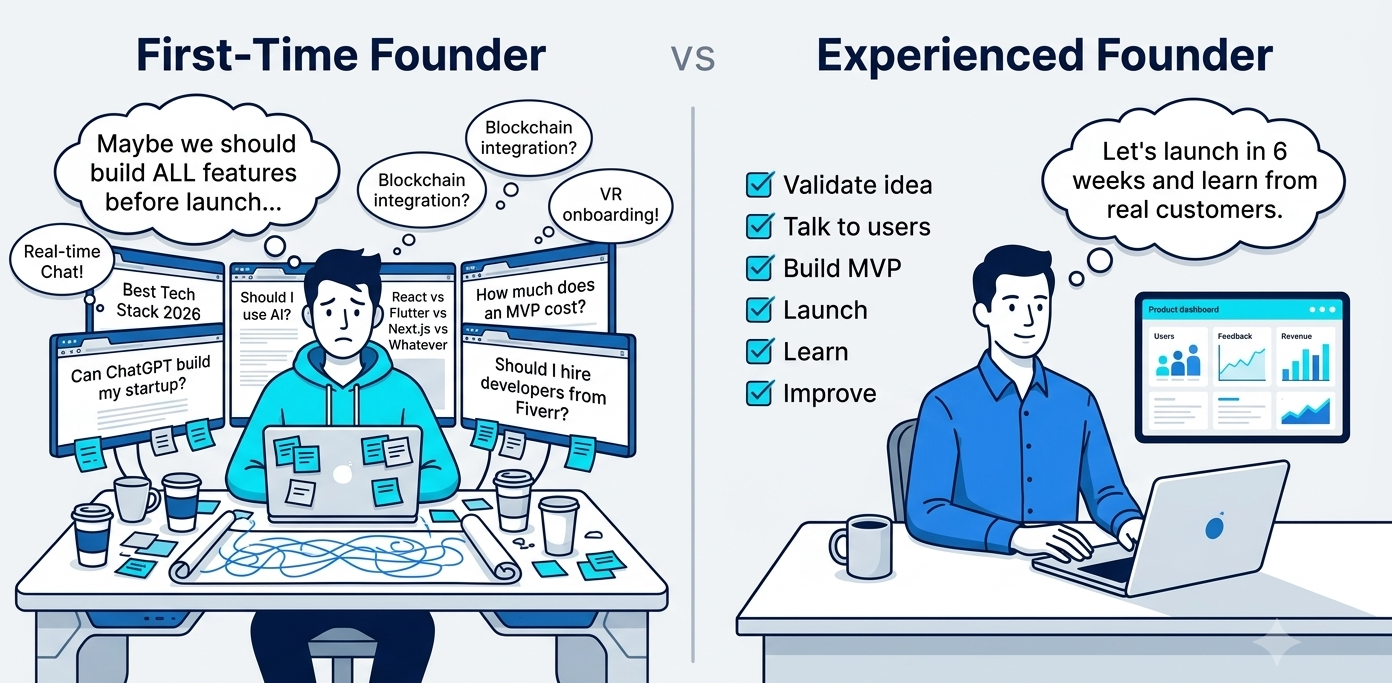
How Do I Choose a Software Development Partner for My Startup?
Quick Answer
Choose a software development partner based on product thinking, startup experience, communication quality, technical leadership, transparency, and proven delivery history—not simply price.
The best development partner acts like a product advisor, not just a coding vendor.
Why This Matters
Many founders evaluate agencies like they are purchasing a commodity.
They compare:
- Hourly rates
- Team size
- Geographic location
But experienced founders evaluate:
- Problem-solving ability
- Product strategy expertise
- Communication style
- Long-term scalability
A startup building an AI-powered recruiting platform has very different needs than an enterprise building internal software.
Your partner should understand your stage.
Founder Mistake
Choosing the cheapest proposal.
A $20,000 project that fails is far more expensive than a $60,000 project that succeeds.
The best software development partner understands your business goals—not just your technical requirements.
"The biggest mistake founders make when choosing a software development company is comparing vendors by hourly rate instead of long-term business outcomes."
Wondering what your own project might cost?
Instead of guessing based on generic online estimates, get a personalized development estimate in minutes.
→ Try BeeWeb's AI Software Cost Calculator
How Do I Evaluate a Development Agency's Portfolio?
Quick Answer
Don't evaluate a portfolio based on design alone. Evaluate business outcomes, technical complexity, industry relevance, and long-term product success.
Ask These Questions
Did They Build It or Just Design It?
Many agencies showcase products they partially contributed to.
Clarify:
- What was their role?
- How long were they involved?
- Is the product still active?
What Business Results Were Achieved?
Look for evidence such as:
- User growth
- Revenue impact
- Funding raised
- Product launches
Can You Speak to Clients?
References reveal far more than case studies.
Ask:
"What would you do differently if you worked with them again?"
That question often produces honest answers. 🧐
What Questions Should I Ask Before Hiring a Development Agency?
Ask questions that reveal process quality, communication standards, technical competence, and accountability.
Essential Questions
- How do you approach MVP development?
- Who owns the source code?
- What happens if timelines slip?
- How are changes handled?
- Who will be my day-to-day contact?
- How often will we communicate?
- How do you estimate projects?
- What QA process do you follow?
- What documentation do you provide?
- What support is available after launch?
Hiring a Development Team: 12 Red Flags Founders Ignore
Many startup failures begin with hiring mistakes.
🚩 Unrealistically Low Pricing
If every proposal is $60,000 and one is $15,000, ask why.
🚩 No Discovery Process
Good agencies ask questions.
Bad agencies provide estimates immediately.
🚩 No Technical Leadership
You should meet someone capable of making architectural decisions.
🚩 No Client References
References should be easy to provide.
🚩 No Product Thinking
Coding alone isn't enough.
🚩 Poor Communication
Slow responses become expensive later.
🚩 Overpromising Timelines
"Three months" sounds great.
Reality often says otherwise.
🚩 No QA Process
Testing should be systematic.
🚩 No Security Process
Especially important for SaaS products.
🚩 No Documentation
Future maintenance becomes difficult.
🚩 Unclear Ownership
Founders should own the code.
🚩 No Post-Launch Support
Launch is only the beginning.
Most project failures are caused by communication and process issues—not technology.
Should I Hire a Local Agency or Outsource Offshore?
Quick Answer
The best choice depends on budget, communication needs, technical complexity, and management preferences—not geography alone.
Local Agency Advantages
- Easier meetings
- Cultural alignment
- Similar business environment
Offshore Advantages
- Lower costs
- Larger talent pool
- Faster scaling
Reality
Modern collaboration tools have significantly reduced the importance of physical location.
The quality of the team matters more than the country.
Eastern European development teams often provide comparable technical quality at significantly lower costs while maintaining strong communication and startup experience.
Talent Quality
Eastern Europe has become a major technology hub.
Countries frequently chosen by startups include:
- Armenia
- Poland
- Ukraine
- Romania
- Bulgaria
Why Founders Choose Eastern Europe
- Strong engineering education
- High English proficiency
- Startup-friendly mindset
- Cost efficiency
Many successful startups use Eastern European teams not because they're cheaper—but because they offer an excellent balance of quality and cost.
20 Questions to Ask Before Signing with a Software Development Company
- Who owns the source code?
- Who owns the repository?
- Who will manage the project?
- What startup experience do you have?
- Can I speak to clients?
- How do you estimate projects?
- How are change requests handled?
- What QA process do you use?
- What security standards do you follow?
- What documentation is included?
- How often will we meet?
- How do you manage risks?
- How do you handle delays?
- What happens if key developers leave?
- What technologies do you recommend and why?
- What is your warranty policy?
- What post-launch support is available?
- How do you measure project success?
- Can the team scale if needed?
- What makes you different from competitors?
Key Takeaways
- Don't choose a development company based solely on price.
- Prioritize product thinking over coding capacity.
- Verify references and past outcomes.
- Protect your IP before development starts.
- Ensure ownership terms are clearly documented.
- Evaluate communication as carefully as technical skills.
- Eastern European teams often provide exceptional value for startups.
- A great software development partner helps shape the product—not just build it.
Building your first product is difficult enough.
Choosing the wrong development partner makes it even harder.
At BeeWeb, we help startups move from idea to MVP with dedicated product teams, AI-powered development workflows, and experienced engineers who understand startup realities.
Whether you're validating an idea, building an MVP, or scaling an existing platform, our team can help you launch faster and reduce technical risk.
Talk to BeeWeb about your product vision and get practical guidance before writing a single line of code.
FAQ
How do I choose a software development company?
Choosing a software development company involves more than comparing hourly rates or technical skills. Look for a partner with relevant industry experience, a strong portfolio, transparent communication, and a proven development process. Review their case studies, client testimonials, and approach to project management. Most importantly, choose a company that understands your business goals, not just your technical requirements.
What questions should I ask a software development vendor?
Before hiring a software development vendor, consider asking:
- Have you built similar products before?
- Can you share relevant case studies or client references?
- What is your development process?
- How do you handle project communication and reporting?
- Who will be working on my project?
- How do you manage changes in project scope?
- What happens after the product is launched?
- How do you ensure quality and security?
The answers to these questions can help you evaluate both the technical capabilities and the reliability of your potential partner.
How much does custom software development cost?
The cost of custom software development depends on several factors, including project complexity, features, integrations, technology stack, team size, and development timeline. A simple MVP may cost significantly less than a large-scale enterprise platform with advanced functionality.
If you're planning a project and would like a rough estimate, try our AI Software Development Cost Calculator to get a personalized projection based on your requirements.
What are the risks of hiring a cheap development company?
While lower rates may seem attractive initially, choosing a development company based solely on price can lead to hidden costs. Common risks include poor code quality, missed deadlines, lack of documentation, communication issues, technical debt, and expensive rework later.
The cheapest option is often the most expensive in the long run if the product needs to be rebuilt or heavily refactored after launch.
How do startups choose a technology partner?
Successful startups look for technology partners who can contribute strategically, not just execute tasks. A good partner helps validate ideas, define an MVP scope, recommend the right technologies, identify potential risks, and support long-term growth.
When evaluating a technology partner, startups should prioritize product thinking, startup experience, communication quality, flexibility, and the ability to scale with the business as it grows.