
Voice AI Integration & Real-Time Communication Features for a Virtual Collaboration Platform
A feature-rich all-in-one virtual events and office platform where remote teams create custom spaces, host webinars for up to 5,000 attendees, collaborate in real time, and manage events end-to-end — with built-in analytics, screen sharing, notes, and a dedicated speaker stage.
- Vue js
- NodeJS
- WebRTC
- WebSockets
Team
1 Project Manager · 1 UI/UX Designer · 2 Full Stack Developers
Overview
SpatialChat is an all-in-one virtual events and collaboration platform designed for remote teams and event organizers. Unlike traditional video conferencing tools, SpatialChat recreates the natural feel of physical spaces — allowing participants to move freely between areas, join conversations organically, and engage the way they would at a real in-person event or office.
BeeWeb was brought in to build and scale the platform's core functionality — from virtual office spaces and large-scale webinar infrastructure to real-time collaboration tools, event management workflows, and a comprehensive analytics suite for meeting creators. The result is a platform now trusted by 6M+ users worldwide, powering events for organizations including Google, Harvard, McDonald's, and Volvo.
Business Challenge
🔹 Replicating Real-Life Spatial Interaction Online
Standard video tools flatten every interaction into a grid of boxes. SpatialChat needed to create a sense of physical presence — where proximity determines who you hear, and movement feels natural and intentional.
🔹 Scaling to Thousands of Concurrent Attendees
Supporting intimate virtual offices alongside webinars of up to 5,000 participants on the same infrastructure required a fundamentally different architectural approach than typical meeting tools.
🔹 Managing Complex Event Formats
Events needed to support multiple simultaneous modes — open networking areas, dedicated speaker stages where only presenters speak, and private breakout rooms — all within one seamless experience.
🔹 Real-Time Collaboration Without Leaving the Space
Participants needed access to collaborative tools — whiteboards, notes, screen sharing — without breaking the immersive spatial experience by switching between apps.
🔹 Giving Hosts Meaningful Data
Event organizers needed more than attendance numbers — they needed to understand how people moved, where they engaged, and how their events actually performed.
Our Solution
🔹 Built a spatial interaction engine where participants move freely between custom virtual areas — with proximity-based audio that replicates natural conversation flow
🔹 Developed a scalable webinar infrastructure supporting up to 5,000 concurrent attendees with a dedicated speaker stage — where only designated speakers are heard by the audience
🔹 Implemented private and public virtual areas within spaces, enabling breakout rooms, networking zones, and presentation stages to coexist within a single event
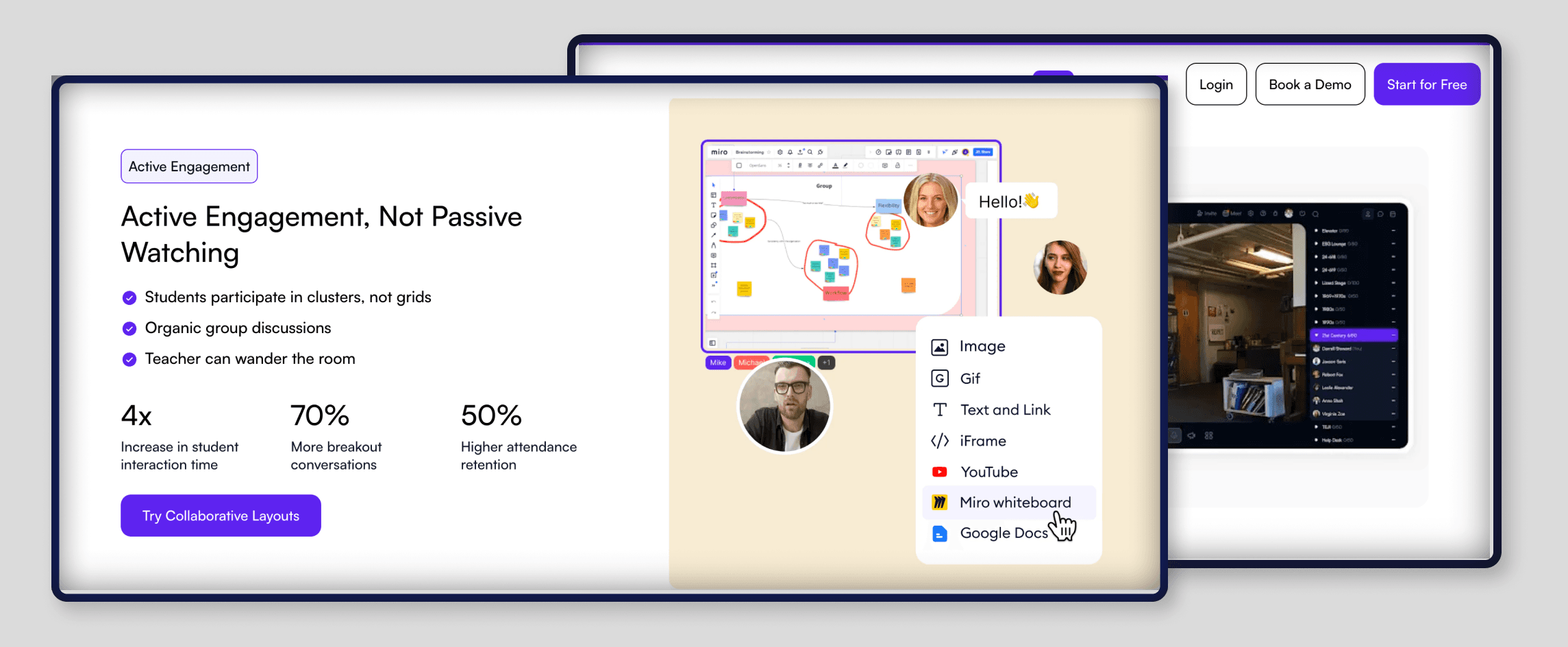
🔹 Built real-time collaborative tools directly into the platform — shared whiteboard, in-space notes, and simultaneous multi-user screen sharing — all without leaving the event
🔹 Developed a full Event Management system allowing organizers to configure spaces, manage speakers, control attendee access, and run events end-to-end from one dashboard
🔹 Delivered a comprehensive Analytics Suite for meeting creators — covering attendance, movement patterns, engagement time, participation rates, and session performance
Development Process
The project ran over 12 months with a team of one Project Manager, one Tech Lead, one Full Stack Developer, and one Frontend Developer. Given the platform's complexity — real-time audio, spatial movement, large-scale event infrastructure, and collaborative tools all running simultaneously — development was structured around tight sprint cycles with continuous performance testing at each stage.
The core architectural challenge was building a system that could serve two very different use cases on the same foundation: an always-on virtual office for daily remote work, and a high-capacity webinar and event platform scaling to thousands of simultaneous participants. These have fundamentally different real-time requirements, and designing the infrastructure to handle both without compromising either was the central engineering focus throughout the project.
The speaker stage feature required particular attention — creating a broadcast layer within a spatial environment where designated speakers address large audiences, while the rest of the space remains open for networking and side conversations. This hybrid mode — stage + open space simultaneously — was one of the most technically complex features of the build.
Technology & Architecture
🔹 Vue.js for a responsive, high-performance frontend with smooth real-time spatial interactions
🔹 Node.js / Express for a scalable backend handling real-time events, room state, user presence, and event management logic
🔹 WebRTC for low-latency peer-to-peer audio and video connections powering the spatial proximity experience
🔹 WebSockets for real-time synchronization of participant positions, collaborative whiteboard state, and in-space notes
Key Features
Spatial Virtual Spaces
🔹 Fully customizable virtual areas where participants move freely and interact based on proximity
🔹 Private areas within spaces for breakout groups, 1:1 conversations, and focused sessions
🔹 Brandable environments with custom layouts for offices, events, and conferences
Webinar & Speaker Stage
🔹 Webinar infrastructure supporting up to 5,000 attendees
🔹 Dedicated speaker stage where only assigned presenters are heard by the audience
🔹 Seamless transition between open networking and stage presentation within the same space
Real-Time Collaboration Tools
🔹 Shared collaborative whiteboard for live visual collaboration
🔹 In-space notes accessible to all participants
🔹 Simultaneous multi-user screen sharing without leaving the event
Event Management
🔹 Full event configuration — spaces, speakers, access control, and scheduling
🔹 Attendee management and session coordination from a single organizer dashboard
🔹 Support for conferences, networking events, town halls, workshops, and virtual offices
Analytics for Meeting Creators
🔹 Real-time and post-event analytics on attendance, engagement, and participation
🔹 Movement and interaction data showing where attendees spent time and connected
🔹 Session performance metrics to help organizers improve future events
Result
🔹 Platform live and scaling — SpatialChat now serves 6M+ users across 10,000+ events worldwide
🔹 2x higher engagement than traditional webinar tools — driven by spatial interaction and natural movement between sessions
🔹 Enterprise adoption — trusted by Google, Harvard, McDonald's, Volvo, McKinsey, and Accenture
🔹 All event formats in one platform — virtual offices, webinars, conferences, career fairs, and networking events running on the same infrastructure
🔹 Recognized by global press — featured in Wired, The Wall Street Journal, TechCrunch, and Fast Company
This project reflects BeeWeb's ability to deliver complex, real-time SaaS infrastructure — combining spatial audio, large-scale event management, collaborative tooling, and analytics into a single cohesive platform used by millions.
Get an estimate
Describe your project by providing a written description or recording a voice message.
Free 30 minutes. A senior engineer, not an SDR. NDA-ready. Replies within one business day.