
Project Cost & Time Estimation in IT: From Theory to Real-World Practice
When people talk about project estimation, it often sounds neat and formulaic — fixed processes, predictable outcomes, and standard budget calculations.
But in real IT projects, theory rarely survives first contact with reality.
Projects evolve. Requirements shift. Teams scale up and down. And what starts as a clear timeline on paper can easily turn into a balancing act of budget control, resource management, and delivery pressure.
As a CFO in an IT company, I’ve seen that accurate cost and time estimation is less about numbers — and more about understanding patterns, risks, and behavior across multiple projects. It’s about creating a system that learns, improves, and adapts over time
Why Traditional Project Estimation Fails?
Most estimation models focus only on:
- Billable hours × hourly rate
- Developer seniority and velocity
- Historical project complexity
But these models ignore:
- Shifting client expectations
- Parallel project dependencies
- Human and AI resource mix (developers + AI copilots)
- Unpredictable integration or testing challenges
In this article, I’ll share how we approach project cost and time calculation in a way that’s grounded in real-life project dynamics — not just theory.
Start With a Clear Project Scope
Accurate numbers start with clear goals. Before estimating anything, we define:
- Deliverables — what exactly will be built
- Feature list — grouped by priority (MVP vs. future phases)
- Tech stack and tools
- Team roles required
A vague scope is the biggest cause of inaccurate estimates.
A well-defined scope is every CFO’s best friend and the foundation of reliable IT project cost estimation.
Break Down the Work into Measurable Tasks
Our technical team converts the scope into a Work Breakdown Structure (WBS) to make every component measurable:
- Each task has a time estimate, a responsible person, and dependencies.
- Tasks are grouped into design, frontend, backend, QA, deployment, and management.
This method transforms an abstract concept into a detailed, trackable structure — a must for accurate project time estimation.
Calculate Effort Hours & Project Timeline
We use bottom-up estimation, which ensures every task is accounted for:
- Effort per task × number of resources = total project hours.
- Add a 15–20% buffer for unforeseen changes or delays.
- Align effort hours with calendar weeks, factoring in holidays, parallel tasks, and realistic team capacity.
This approach helps us create realistic project timelines, not overly optimistic ones.
Add Financial & Strategic Layers
Not all projects are equal. We always consider:
- Strategic importance (long-term partnership vs. short engagement)
- Project complexity and risk level
- Currency and payment terms
This ensures that our project pricing aligns with the company’s financial strategy, not just operational delivery.
Build Transparency with Clients
Clients appreciate clarity more than low prices. That’s why we:
- Share the detailed cost and time breakdown
- Clearly define in-scope and out-of-scope items
- Establish transparent change-request rules
This builds trust, avoids surprises, and keeps all sides aligned.
AI’s Role in Smarter Estimations 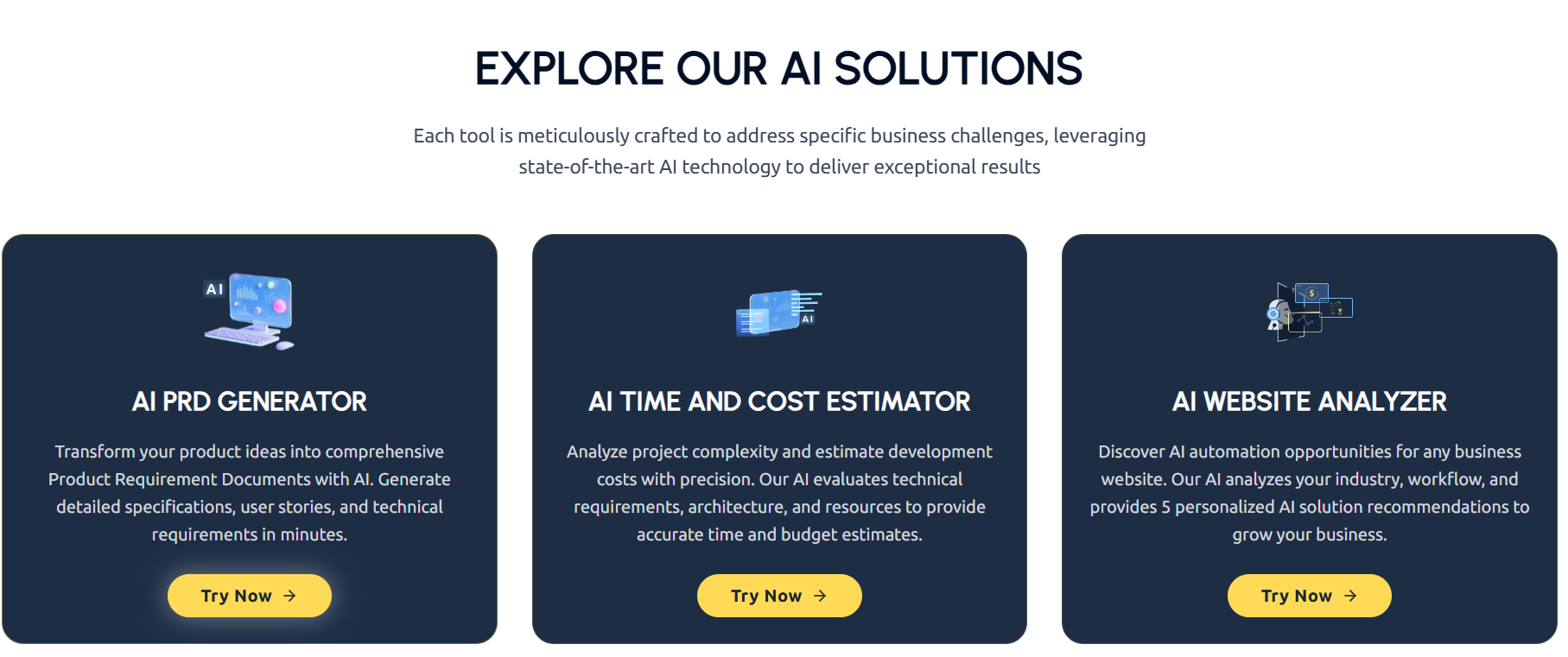
Modern estimation goes beyond spreadsheets. We now leverage AI-driven tools to process data from past sprints, identify bottlenecks, and predict resource burn. This allows our teams and finance leads to:
- Make faster and more transparent budget forecasts
- Detect early signs of project scope creep
- Improve collaboration between project managers and financial teams
To make this process scalable and practical, we developed the BeeWeb AI Estimator — a tool designed to bring clarity, consistency, and intelligence to project planning.
Whether you upload your project description or type it manually, the Beeweb AI Estimator provides a fast, data-backed estimate that makes early-stage decision-making more transparent, precise, and efficient.
👉 Try Beeweb AI Estimator today and discover how AI can make project planning simpler, smarter, and more reliable.
Read also:
AI Website Analyzer
AI PRD Generator