
Mobile App Security Checklist for 2026/2027: What Investors and App Stores Both Check
A mobile app security checklist for 2026 has to satisfy two reviewers. Apple and Google check encryption, authentication and whether your privacy disclosures are accurate before they approve a submission. Investors check the same basics, plus architecture, scalability and regulatory compliance, before they fund a deal. The two lists overlap on core security engineering and split on scale and governance. This guide covers both, along with the 2026 deadlines already in force.
Most teams treat shipping a mobile app as the finish line. It isn't. It's the point where two different audiences start checking your work against two different lists, and neither list is forgiving.
Apple and Google check your app against a policy checklist on every submission, and increasingly on every update. Miss a requirement and you don't get a warning, you get a rejection, or worse, a published app that can no longer ship a fix.
Investors check your app against a due diligence checklist before they wire money, and a startup with critical security gaps has watched deals stall or shrink over exactly this kind of finding. It's the same scrutiny we recommend founders apply to their own development partner selection — if you wouldn't hire a team without checking their security process, don't expect investors to fund one without checking yours.
The uncomfortable overlap: these two checklists share more than people expect. Encryption, secure authentication, data handling, and privacy disclosure show up on both. Get the engineering right once, and you've mostly cleared both bars. This guide walks through what each side actually checks, where the two lists diverge, and the 2026-specific deadlines that are already blocking submissions.
This isn't a generic OWASP-style engineering checklist — those exist already and are worth using alongside this one. This guide is specifically about the intersection: what to prioritize when the same codebase has to survive both a platform review and an investor's audit, often in the same quarter.
Why Mobile App Security Now Matters to Two Very Different Audiences
App stores check security to protect their users and their platform's reputation; investors check it to protect their capital. Both have gotten measurably stricter in 2026, Apple and Google have tightened review enforcement, and investors increasingly treat a security gap as a red flag serious enough to affect valuation or kill a deal.
Mobile apps now handle personal data, payment details and, more and more, health records. One security gap can mean a breach, a regulatory fine or lasting damage to your reputation. Investors price that risk into the deal. If an audit finds API vulnerabilities that will take months of engineering to fix, expect that cost to come off your valuation, or the round to wait until the work is done.
The practical implication: security isn't a box you check right before submission or right before a raise. It's infrastructure that needs to exist before either moment arrives.
What App Stores Actually Check in 2026
Apple and Google review for secure data transmission, proper authentication, accurate privacy disclosures, safe handling of purchases, and — increasingly — whether your declared privacy practices match what your app actually does. Both platforms have real 2026 deadlines that block submissions or updates outright if missed.
The technical baseline both platforms check
- Encrypted communication everywhere. HTTPS across every endpoint, valid certificate checks, no insecure fallback. Certificate pinning is expected for higher-risk endpoints — login, payments, anything handling personal data.
- Secure session and token handling. Tokens belong in platform-native secure storage (Keychain on iOS, Keystore on Android) — not local storage, not anywhere an attacker could lift them and hijack a session. Sessions should expire on inactivity and require re-authentication for sensitive actions.
- Server-side purchase verification. If your app handles payments or subscriptions, client-side purchase status can't be trusted alone — verify every transaction against the App Store or Google Play server before unlocking anything.
- Accurate privacy disclosures. Both platforms require your declared data practices (Apple's Privacy Nutrition Labels, Google Play's Data Safety section) to match what the app actually collects and does — a mismatch is now a common rejection reason, not a minor technicality.
- Justified permissions. Requesting camera, location, or contacts access without a clear, declared reason for that specific permission is a frequent cause of review delay or rejection.
2026-specific deadlines worth knowing now
- Google Play target API level. Since August 31, 2026, new apps and updates must target Android 16 (API level 36). Teams that requested an extension have until November 1, 2026. This is easy to miss because nothing fails until you upload. An app below the required level stays live for existing users, but you can't ship updates to it, including security patches, until you raise the target level.
- Google Play Billing Library 8 or later. Since August 31, 2026, Google Play no longer accepts new apps or updates that use Billing Library 7 for in-app purchases. The extension deadline is November 1, 2026. Version 8 removes several older purchase APIs, so plan for real migration work, not a one-line version bump.
- Age-appropriate features. Both stores are tightening how apps handle content and features that aren't suitable for minors. If your app has any, check your age rating and content declarations in App Store Connect and Play Console before you submit. Mentioning it in the privacy policy isn't enough.
The pattern across all of these: almost every one of them fails silently. Nothing breaks in your build. It just stops you from shipping the next update — which is a considerably worse position than a clean rejection on day one, because by then you have real users depending on a version you can no longer patch.
What Investors Actually Check in Technical Due Diligence
Investors look for encrypted data, secure authentication, and evidence of vulnerability scanning as baseline hygiene — but the deeper question is whether your current architecture can survive 10x growth without a full rewrite, and whether your security posture holds up under an independent audit, not just your own assurance.
Technical due diligence on a mobile app typically covers a wider net than app store review does, but security sits near the top of it in every serious framework. In plain terms, technical due diligence is an investor's independent audit of your product's code, architecture, and security — done before funding, to confirm the technology can support the business it's meant to run. It covers:
- Basic security hygiene — is data encrypted at rest and in transit, is authentication implemented properly, has the codebase been vulnerability-scanned recently
- Code quality and maintainability — disorganized code or heavy repetition ("code smells") is treated as a signal the product was built under time pressure without proper review, which correlates with hidden security debt
- Scalability under real load — can the current architecture actually handle meaningfully more users without a rebuild, since a security fix bolted onto a fragile architecture rarely holds
- Regulatory compliance — GDPR, HIPAA, or other data protection regulations relevant to your users and industry, checked against what the app actually does with personal data, not just what the privacy policy claims. The same access-scope and vendor-agreement questions we cover in how to protect your data when building an AI product apply directly here if your app has any AI features.
- Third-party and infrastructure risk — access control policies, encryption methods, and whether vendor dependencies (SDKs, analytics tools, ad networks) introduce data exposure the founding team hasn't fully mapped
The money at stake is real. A security finding in due diligence rarely kills a deal on its own, but it changes the terms: a lower valuation, money held back until the fixes are done, or a round that waits while your team does unplanned work. Compliance gaps cost even more. Under GDPR, mishandling personal data can lead to fines of up to 4% of global annual revenue, and to orders to stop processing EU users' data.
The founder-level takeaway: technical due diligence should start long before an investor asks for it. Waiting until term sheet stage to find out your architecture has a scaling ceiling, or your data handling has a compliance gap, turns a fixable engineering problem into a deal-threatening one.
Where the Two Checklists Overlap — and Where They Diverge
Encryption, authentication, and data handling satisfy both audiences at once. Where they diverge: app stores care about disclosure accuracy and permission justification; investors care about architectural scalability and whether the same standards hold up under an independent, adversarial audit rather than your own documentation.
| Requirement | App stores check | Investors check |
|---|---|---|
| Encrypted data in transit/at rest | ✅ Required for approval | ✅ Baseline expectation |
| Secure authentication & session handling | ✅ Required for approval | ✅ Baseline expectation |
| Accurate privacy disclosure | ✅ Must match actual behavior | Reviewed as part of compliance |
| Server-side payment verification | ✅ Required if IAP is used | Reviewed as part of architecture |
| Scalability under 10x growth | Not checked | ✅ Central question |
| Code quality / maintainability | Not checked | ✅ Central question |
| Regulatory compliance (GDPR, HIPAA) | Partially — via disclosures | ✅ Directly audited |
| Independent penetration testing | Not required | Often explicitly requested |
The practical upshot: building to satisfy app store review gets you most of the way to satisfying an investor's baseline security check, but not all the way. Investors dig deeper into whether your architecture can scale and whether your team's own security claims hold up against an outside audit — which is exactly why serious due diligence sometimes includes hiring a firm to actually test the product against real attack patterns, rather than taking the team's word for it.
The Checklist: What to Actually Fix, In Order
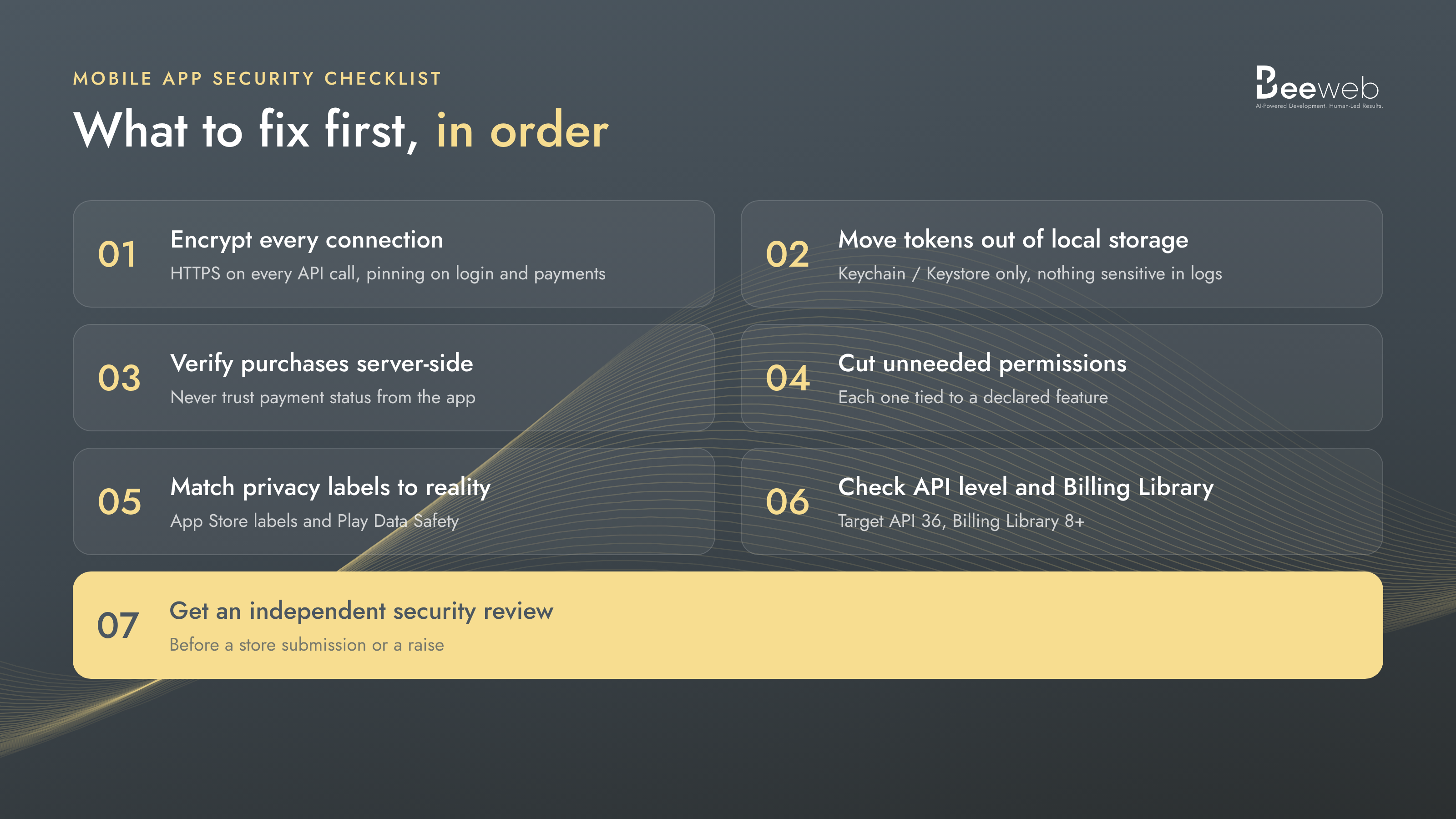 If you're preparing for either a store submission or a funding conversation, this is roughly the order of priority. If a fix on this list turns into a larger rebuild, our AI Cost Calculator is a quick way to gut-check what that's likely to cost before committing budget.
- Encrypt everything in transit — HTTPS with certificate validation across every API call, certificate pinning on sensitive endpoints
- Move tokens and secrets out of local storage — platform-native secure storage only, nothing sensitive in logs
- Verify purchases server-side — never trust client-reported payment status
- Audit your permission requests — drop anything not tied to a declared, justified feature
- Match your privacy disclosures to reality — App Store Privacy Labels and Google Play Data Safety should reflect actual data collection, not a template filled in quickly at submission time
- Check your target API level against current deadlines — don't find out at upload time
- Run an independent security review before you need one — for either an app store resubmission scare or an investor's due diligence request, not after. The same vendor-evaluation questions we lay out in the AI integration buyer's guide apply to any security partner you bring in: ask what happens after the audit, not just what the report says on day one.
Key Takeaways
- App stores and investors check overlapping but not identical lists — encryption, authentication, and data handling satisfy both; scalability and code quality are investor-specific
- 2026 deadlines are already in force and fail silently. Since August 31, 2026, Google Play has blocked updates from apps that don't target Android 16 (API 36) or still use Billing Library 7. Extensions end November 1, 2026.
- Security gaps found in due diligence change the deal terms: lower valuations, money held back, or delayed rounds
- Technical due diligence should start before an investor asks for it, not in response to a term sheet
- The cheapest time to fix any of this is before submission or before a raise — the same pattern we see in every project rescue: retrofitting security is a rebuild, designing it in is a conversation
A mobile app that passes review and survives due diligence isn't lucky. It was built that way from the start.
At BeeWeb, we build mobile apps and SaaS platforms with the security architecture that holds up under both app store review and investor scrutiny — not retrofitted after either one asks. Our QuestionPro voice AI case study is one example of that discipline applied to a production system handling real user data at scale. If you're adding AI to your mobile app, our guide on AI mobile app development in 2026 covers the security considerations specific to AI features.
Preparing for a store submission or a funding round and not sure where your app actually stands? Book a free consultation and get an honest technical read before either one catches you off guard.
FAQ
What do Apple and Google check for mobile app security?
They check encrypted connections (HTTPS everywhere), secure token storage in Keychain or Keystore, server-side purchase verification, a justified reason for each permission, and privacy labels that match what the app actually collects.
What is the Google Play target API requirement in 2026?
Since August 31, 2026, new apps and updates on Google Play must target Android 16 (API level 36). Teams that got an extension have until November 1, 2026.
Which Google Play Billing Library version is required in 2026?
Version 8 or later. Google Play stopped accepting new apps and updates on Billing Library 7 after August 31, 2026, and the extension ends November 1, 2026.
What do investors check in mobile app technical due diligence?
Basic security (encryption, authentication, recent vulnerability scans), code quality, whether the architecture can handle 10x more users, regulatory compliance such as GDPR or HIPAA, and risks from third-party SDKs and vendors.
When should a startup run a security audit?
Before a major store submission or a fundraise, not after an investor asks. Fixing issues found early costs far less than fixing them under deadline pressure.