
Your Lovable or Bolt MVP Got Traction. Now What? A Guide to Scaling Past the AI Builder
You built it in a weekend. People signed up. Some of them are paying. Then the strange stuff starts: a feature that worked yesterday breaks when you ask the AI to fix something unrelated, a user emails to say they can see someone else's data, and your Supabase bill doubles in a month.
Congratulations. Your MVP worked. That's exactly why it's starting to struggle.
Lovable and Bolt are great at getting an idea in front of real users fast. They're not built to carry a growing business on their own. This guide is for the stage in between: you have traction, you don't want to throw away what's working, and you need a plan for what comes next.
The short version: most traction-stage MVPs don't need a full rebuild. They need a code audit, a security fix list, and a clear decision about which parts to keep, harden or replace.
7 signs you've outgrown the AI builder
You don't need all seven. If three or more sound familiar, it's time to plan the next step. 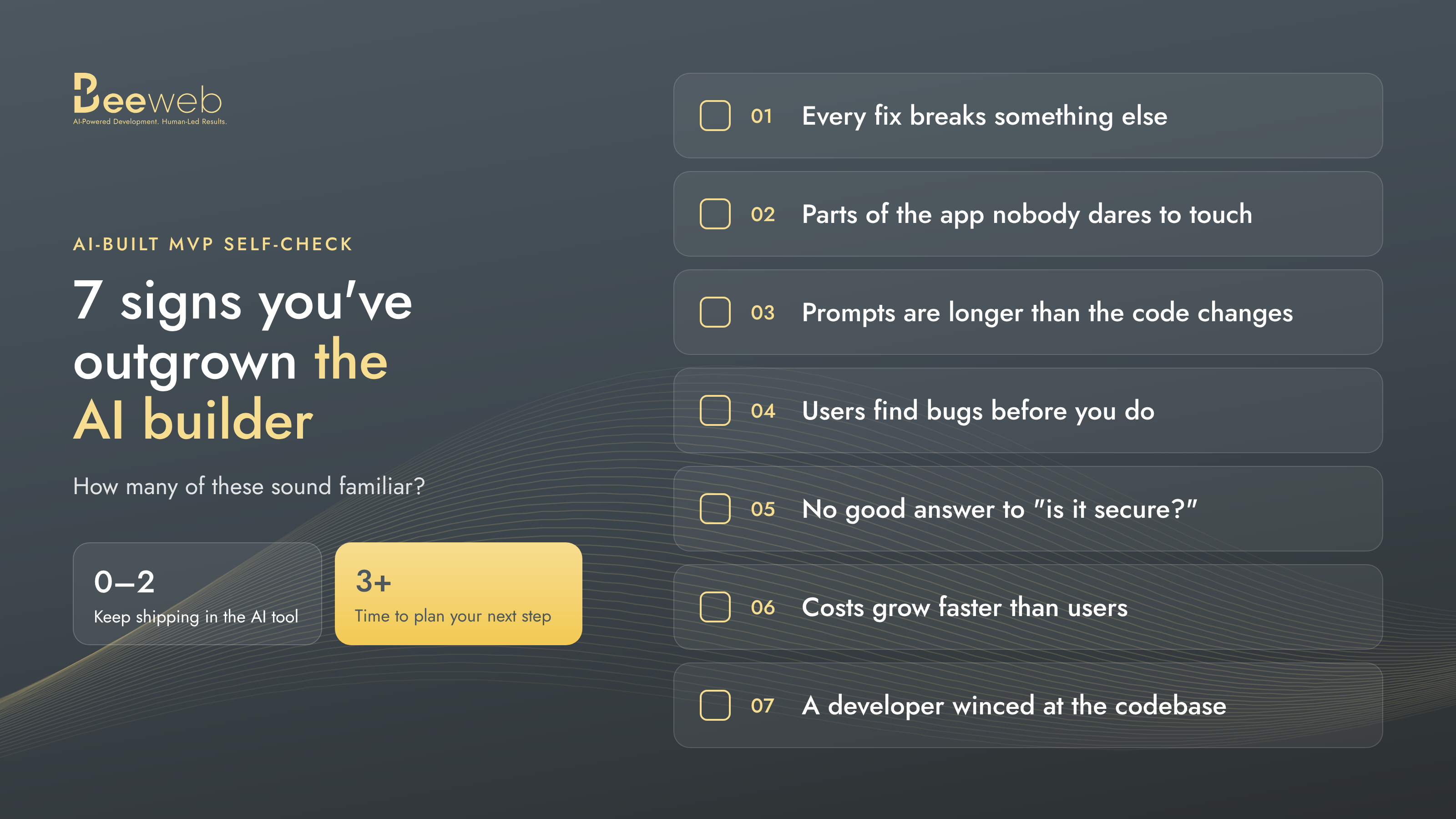
- Every fix breaks something else. You ask the AI to change a button and the checkout flow stops working.
- You're afraid to touch certain parts of the app. Nobody, including you, fully knows how they work anymore.
- Prompts are getting longer than the code changes. You spend an hour explaining context for a ten-minute fix.
- Real users are finding bugs before you do. There are no tests, so customers are your QA team.
- A customer or investor asked about security. And you didn't have a good answer.
- Costs are growing faster than users. Database, hosting or AI credits jump every month without a clear reason.
- You want to hire a developer, and they winced. An experienced engineer looked at the codebase and asked how much time they'd get to clean it up.
What usually breaks first
AI builders optimize for "it works on screen." Production needs "it works for 5,000 people at once, and nobody can see anyone else's data." Those are different goals, and the gap tends to show up in four places.
Security
This is the big one. A 2025 study of 1,645 apps built on Lovable found 170 of them exposing personal data, and about 70% had row-level security turned off. That's the database setting that stops one user from reading another user's records. In 2026, a researcher found 16 vulnerabilities in a single Lovable-hosted app, exposing 18,697 user records.
The usual suspects are API keys sitting in front-end code, missing access rules on the database, and login logic that trusts whatever the browser says.
Data structure
AI tools design the database for the first version of your idea. Three pivots later, you have duplicate tables, columns nobody uses, and reports that don't add up. Fixing this gets harder with every new user, so it's worth doing early.
Architecture
AI-generated code tends to repeat itself. The same logic lives in five places, so a change in one place quietly misses the other four. There's usually no clear separation between front end, business logic and data, which makes every new feature slower to add than the last.
Cost
What felt free at 50 users starts to add up at 5,000. Inefficient database queries, AI calls on every page load and no caching all show up on the monthly bill.
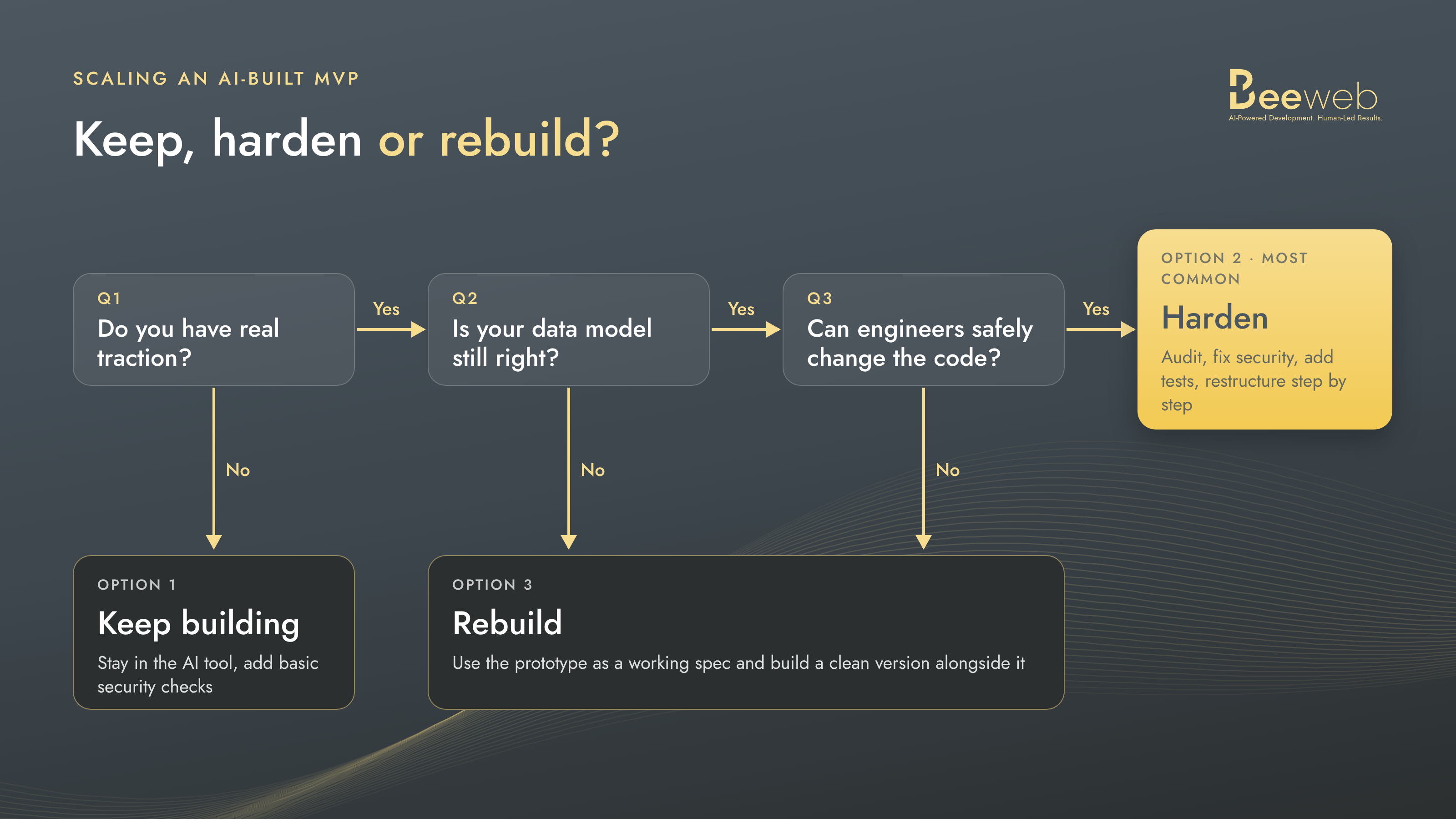
Keep, harden or rebuild: your three options
Founders usually think the choice is "stay on Lovable forever" or "throw it away and start over." Neither is usually right. There are three real options, and most products end up using a mix of them.
|
|
Keep building in the AI tool |
Harden what you have |
Rebuild |
|---|---|---|---|
|
Best for |
Early validation, under ~100 active users, no sensitive data |
Real traction, a product that mostly works, problems you can list |
Wrong data model, the product has pivoted, or the code can't be safely changed |
|
What happens |
Keep shipping fast, add basic security checks |
Export the code, fix security, restructure the worst parts, add tests and CI |
Use the prototype as a working spec and build a clean version alongside it |
|
Typical timeline |
Ongoing |
Weeks to a few months |
A few months |
|
Risk |
Security gaps grow with your user base |
Low, because users keep using the live product |
Higher. Needs a careful migration plan |
|
What you keep |
Everything |
Most of the UI and logic |
Your learnings, designs and user flows |
The middle option is the one most teams skip, and it's often the cheapest. You keep what users already like, fix the foundation underneath, and only rebuild the parts that truly have to go.
How to scale past the AI builder, step by step
This is the order we'd follow for a traction-stage MVP. The first two steps matter most, because they protect the users you already have.
1. Get your code out
Make sure the code lives in a GitHub repository you own, not only inside the builder. Lovable syncs to GitHub, and Bolt lets you export your project. Do the same for your database: know where it's hosted, who has admin access, and how to back it up.
2. Fix the security holes first
Before any new features: turn on row-level security for every table, move API keys and secrets to the server, check that every API endpoint verifies who's calling it, and rotate any keys that were ever exposed. This is usually a few days of focused work, and it's the step you'll be most glad you did if an investor or enterprise customer ever asks.
3. Run a proper code audit
Have an experienced engineer go through the codebase and sort everything into three piles: fine as it is, needs cleanup, needs replacing. This gives you a real plan and a real budget instead of a guess.
4. Add a safety net
Write automated tests for the flows that make you money: signup, login, payments and your core feature. Set up CI so every change is tested before it goes live. From this point, a fix in one place can't silently break another.
5. Restructure the worst parts
Use the audit to fix the data model, pull repeated logic into shared modules, and separate front end, back end and database cleanly. Do it in small steps while the app stays live, not in one big rewrite.
6. Set up monitoring
Add error tracking, uptime alerts and cost alerts. You want to hear about problems from a dashboard, not from an angry customer.
7. Decide how you'll keep building
Some teams keep using AI tools for prototypes and UI experiments, with engineers reviewing everything before it ships. Others move fully to a traditional workflow. Either works. What doesn't work is AI-generated changes going straight to production with nobody checking them.
Your prototype did its job
Lovable or Bolt got you to real users faster than any team could have. That's a win, not a mistake. The next stage just needs something different: engineers who can take what's working, make it safe, and get it ready for the next 10,000 users.
That's what we do at BeeWeb. We turn AI-built MVPs into secure, production-ready software without starting over. We've also scaled products from MVP to real scale, like Service Club, which grew to more than 200,000 users in 11+ countries.
Book a free MVP code review. You'll talk directly with our CTO, and you'll leave with a clear keep / harden / rebuild plan for your app.
FAQ
Can a Lovable or Bolt app scale to thousands of users? The code can, but usually not as it was generated. Most AI-built MVPs need security fixes, a cleaner data model, automated tests and monitoring before they can safely handle thousands of active users.
Do I have to rebuild my Lovable app from scratch? Usually not. Most traction-stage MVPs can be hardened: export the code, fix security, restructure the weakest parts and add tests. A full rebuild only makes sense when the data model is wrong or the product has changed direction.
Is a Lovable app secure enough for real users? Not by default. A 2025 study of 1,645 Lovable apps found 170 exposing personal data, mostly because database access rules were turned off. Turning on row-level security and moving secrets to the server should come before any new features.
Can I export my code from Lovable or Bolt? Yes. Lovable syncs your project to GitHub, and Bolt lets you export it. Make sure the repository and the database are under accounts your company owns.
How long does it take to make an AI-built MVP production-ready? Security fixes usually take days. A full hardening, with an audit, tests, restructuring and monitoring, typically takes a few weeks to a few months, depending on how big the app is and how much of the code can be kept.